Saturday, April 2, 2011

A Southern Sojourn


As far as I can recollect, the year was, 2005, the month was December, however we had left behind the nip in the air, in Kolkata. It was the last phase of our South India trip. we were a motley group of family and friends, ages ranging from 2, (that of my daughter) to 65, (that of my father). We were in the last lap of our South India trip. We had traveled from Howrah to Chennai, in Coromondal Express. Chennai greeted us with rains in December. A local of Chennai, had informed us that there were three seasons in Chennai - HOT, HOTTER and HOTTEST, and we were pleasantly surprised at the pleasantness of the weather. We reached the TTDC hotel, which was a statement in antiquity itself. The plaster was off most of the walls, and water was seeping in but the lady at reception, with the fragrance of jasmine on her thick oiled hair comforted us with the promise of 'hot kafi'.

After the usual tourist rounds at Marina Beach, its idly stands and balloons we went to Fort St. George, My son, who was all of 10 years at that time, thoroughly enjoyed taking his photo beside the huge cannon. The ladies in our group, including me, had our one-point destination etched out in our minds...Nalli, Kumaran and Pothys and we were in no mood to be distracted from our focus. So after packing off the boys and the kids, to the hotel, we made a headway to our Moksh.

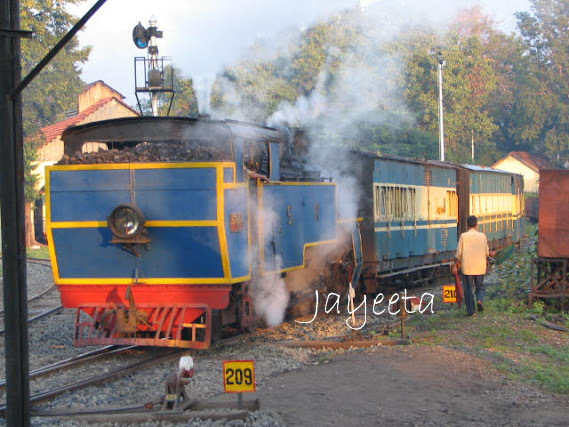
The next evening, saw us boarding the Nilgiri express, our destination -Mettupalayam, the gateway to Ooty, in expectation of cooler climes. Early next morning, saw us at Mettupalayam station. The early morning mist, the steam from the blue Nilgiri Passenger train, the inviting aroma of hot coffee, the blue mountains beckoning us, the quaint and very clean platform with almost a doll-house like feel, and the much awaited bite in the air, made me fall in love with the place, instantly.

I loved Ooty from the first glimpse that I had of it. It is like any other British Summer destinations in India, but had retained its native flavor. The Ooty Botanical Gardens, The Ooty Lake and the Doddabetta peak ,the highest peak in the Nilgiris, and its telescope, which provided a 180 degree view of the Nilgiris captured
 my interest. However, the feeling that stuck on to my senses were those of the musty smell of the British era "Chellaram" shop, which sold from toothpaste to tobacco and toys, as well as home-made chocolates, the heaps of spices like cardamom, and black pepper lying on the road, waiting to be sold, the shops selling different oils, like clove oil, cardamom oil, the rolling tea gardens on the way to Coonnor, where I had the tastiest and sweetest pineapple, that I have ever had in my life and in Sim's Park where, there were many 'Rudraksh' trees. To put it briefly, I must say, that Ooty, has the power to seduce every sense in an individual.

Our next stop was Madurai, the temple city. on the banks of the river Vaigai. The Cultural Capital of Tamil Nadu, once the capital city of the great Pandya rulers, boasts of the World-Renowned Meenakshi Amman Temple.The temple complex is dedicated to Lord Sundareshwara, as Shiva is known here, and his consort Parvati, or Meenakshi. The temple complex has huge water tanks, and is resplendant with mighty stone pillars and magnificient Gopurams. The intricate figures carved out on the pillars and the gopurams depicted scenes from our epics and were an array of colors. Each figure, is painted in a different color, suited to that character. Madurai is a great place to bargain for bell-metal lamps and figurines.

One frivolous/important observation, I must add in here. each of the places, that I visited in TamilNadu, offers different variants of Dosa, inherent to that place.

We took the Vaigai Express from Madurai to Villupuram. We reached, Villupuram, when, dawn was breaking, it was still quite dark, and we had to wake up an old porter to help us carry our luggage. As we crossed the tracks, and exited the station, I noticed a small temple, decorated with small electric bulbs, constant chanting of shlokas, in a deep baritone, made me feel very peaceful at that hour, when the world was still sleeping. Fragrance of jasmine flowers and agarbatti was seeping into my senses. It was an ethereal feeling as we took a tempo traveller to 'Matri Sharanam" the rest house of the Pondicherry Aurobindo Ashram.

Written by: Jayeeta Sinha Roy
Photos: Jayeeta Sinha Roy

Thursday, August 7, 2008

Madarihaat/ Totopara

A Toto Village

Barodabri is a small locality within Madarihaat subdivision of Jalpaiguri in North Bengal. Madarihaat is the gateway to the Jaldapara Wild Life Reserve, home to about 50 one-horned rhinos, and this is the place, where the West Bengal forest department has built a forest bungalow.I visited this area around the first week of August, But I think that the best time to visit this place, is late September till February, as on other times as the rains hinder the wildlife sightings, and the reserve is closed from 15th June to 14th September.

The village School
There are a sprinkling of forest dept and tourism dept bungalows in the upper Dooars region, spreading across the Coochbehar and Alipurduar districts. Another attraction of this place is the showcase of the lifestyle of the indigeneous Indo-Bhutanese tribe called the totos, found in a small enclave called Totopara, about 22 kms from Madarihaat. Anthropologists are all agreed on the view that the culture and the lifestyle as well as the language of the Totos are absolutely unique to them. They are distinctly different from the other tribes, of that area, namely the rajbanshis, which is the largest and the koch, which is of tibeto burmese origin and is presently scattered around Assam and Tripura, or the mech.

The entire Toto population is spread across 6 villages, known as Mitragaon, Subbagaon, Pujagaon, Dhumchigaon, Mandalgaon and Panchayatline(gaon). The main source of income for these people is agriculture. Pineapple, betelnut and ginger is grown in abundance. They are mainly animistic, they worship nature.Mawa or wine and roti is their staple diet.

Dry bed of the river Torsha
However, the Toto tribe is severely endangered now owing to their marriage practice. They are endogamous, meaning that they marry within their tribe. This has led to genetic defects in children born out of these marriages, mainly thallasemia. The elders in the tribe are slowly becoming aware of the pitfalls of this endogamous system of marriage, and hopefully will bring about a change in their norms inorder to save the tribe from extiction. The Totos generally do not believe in divorce and live together during their engaged period to find out whether they are compatible or not as partners. If not, they go their separate ways, without much hue or cry.

Cherrapunji Pics


Posted by Picasa

Umiam/Barapani ~ Cherrapunji

A very off the beaten track place, that I wanted to write about is one endowed with extreme natural beauty. The name of the place is Umiam, about 16 kms from a oft visited tourist spot, Shillong. This place is known as the Barapani by the locals and is located in the Ri-bhoi district of Meghalaya.I visited this place on the 3rd of December 2007, and was mesmerised by the endless serpentine lake, entwining the foothills of the Khasi hills.

The view of the lake from the Orchid Lake Resort, run by the Meghalaya Govt is nothing short of gorgeous. The slopes, leading down to the shores are heavily guarded by hefty pine trees and myriad flower shrubs, mostly those of what the locals call the chinese rose, and which I later discovered to be giant 'gandharaj' flowers. These are white in colour and emanates a sharp perfume, especially at night, which sort of numbs one's senses. I can keep on going back to that resort in the khasi hills if only to experience the peace evolving out of the moonlight shimmering on the Umiam, the hypnotizing smell of these 'Raat Ki Rani flowers and the feeling of 'there is no tomorrow'.

The shadows of the mountains on the waters of the lake, impart a serenity and peace to the place which is beyond articulation. Another added attraction is the water sports complex near the Lake Resort.


The 55 km drive from Shillong to Cherrapunji, touted as the wettest place on the earth, till it gave up its position to Mawsynram was comfortable.The rolling meadows offered a feast for the eyes. However, the showstopper was the dry, barren landscape of Cherrapunji. A farcry from the lushness and the greenery that my mind's eye had envisaged. The Ramkrishna Mission and the Noh kalikai falls are the only places worth visiting in Sohra. This is the name by which the locals recognize Cherrapunji.

Intrigue-Kurseong May 2008

 
Posted by Picasa